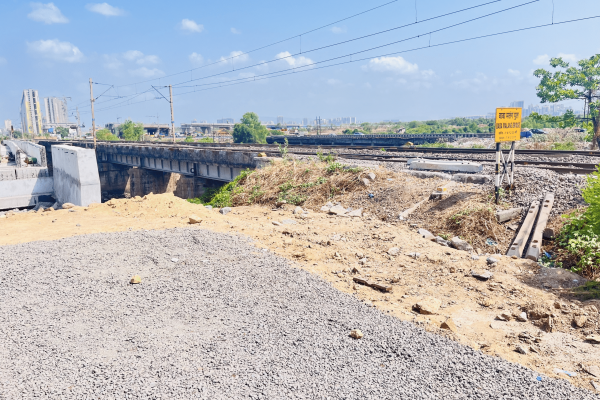
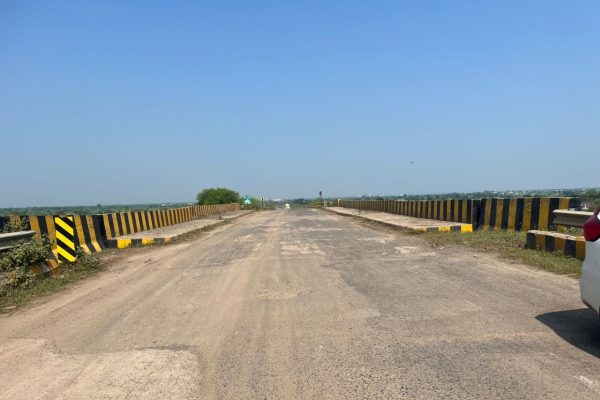
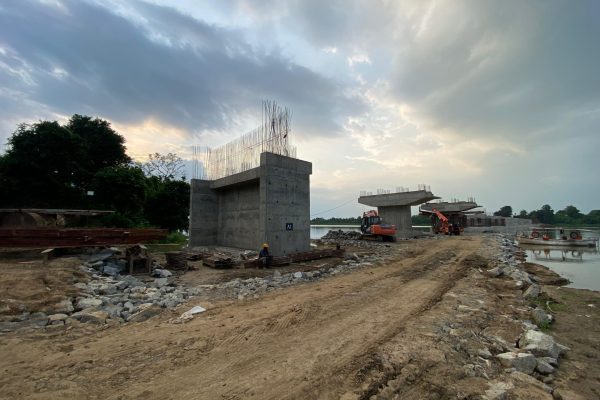
The Karanja Road Improvement Project under the Hybrid Annuity Model (HAM) includes major enhancement works across two key corridors—60(A) and 60(B)—in the Wardha district. Under Package 60(A), the project covers improvement of the Karanja–Waghoda–Jalalkheda Road SH-323 from Km 40/00 to 50/384 with an actual length of 10.384 km, and improvement of the Hingni–Bordharan–Dhanoli–Kajali–Savali to NH-06 MDR-58 stretch from Km 23/00 to 44/900 with an actual length of 21.90 km, creating a combined upgraded length of 32.284 km. Under Package 60(B), the work focuses on upgradation of the Pardi–Sarwadi–Chicholi–Selgaon–Umari–Saval–Ajandoh–Kannamwargram Road MDR-06 from Km 3/600 to 30/697 in Taluka Karanja, with an overall length of 27.097 km. Together, these corridors enhance mobility, connectivity, and infrastructure performance across the Karanja region. Our engineering scope included extensive survey operations such as DGPS-based topographic survey, establishing traverse stations every 5 km, installing TBMs at 250 m / 500 m intervals, recording centre-line coordinates at 10 m and 5 m intervals, and capturing OGL and cross offsets as per MoRTH (Revision-05) guidelines. Complete Plan & Profile drawings were prepared and submitted for approval, along with detailed 30-m interval cross-sections as per IRC:SP:73-2018.
The project further involved comprehensive traffic engineering and pavement design tasks, including Traffic Volume Count Surveys, detailed analysis as per IRC/IS/ASTM codes, Axle Load Surveys and spectrum preparation, and multiple pavement condition assessments. Additional field investigations included CBR testing, Benkelman Beam Deflection (BBD) testing, and geotechnical testing to determine soil strength, structural capacity, and pavement requirements. We also carried out detailed road inventory and structural inventory work, assessed junction conditions, and recommended improvements for drainage, alignment, and roadway geometry. A major highlight of the project was the planning and advisory for utility shifting, which involved relocation of electric poles, adjustment of water pipelines, and managing roadside tree-lines to prevent future conflicts during construction. Through meticulous engineering, accurate data collection, and strict adherence to IRC and MoRTH standards, the project delivers a technically sound foundation for high-quality road construction, improved safety, and long-term regional development.